

Gluten Sensitivity: Differences from Celiac Disease, Symptoms & Tips
Do you often experience abdominal pain, diarrhea, bloating, or other discomforts after eating cake, bread, or pasta, and your doctor rules out celiac disease as the cause? Then you might have gluten sensitivity. Symptoms of gluten intolerance can vary greatly and sometimes resemble those of other digestive and metabolic diseases. In this article, you will learn about the possible symptoms of gluten sensitivity, the difference between gluten sensitivity, celiac disease, and wheat allergy, how to classify celiac disease symptoms, and what everyday tips can help.
Correctly Classifying Gluten Intolerance Symptoms
Stomach ache, diarrhea, or bloating after eating gluten-containing foods can have various causes. It's important not to hastily categorize the symptoms, but rather to clearly differentiate potential triggers.
Learn more
Gluten sensitivity, celiac disease, or wheat allergy?
Gluten sensitivity, celiac disease, and wheat allergy are often confused in everyday life. Medically, however, they are distinct reactions to gluten, wheat, or gluten-containing foods.
Learn more
Symptoms and potential consequences
Gluten sensitivity symptoms and celiac disease symptoms can be similar, but they have different causes. Especially with celiac disease, potential consequences and complications are important.
Learn more
Step by Step to the Correct Clarification
Gluten sensitivity cannot simply be self-diagnosed. Medical diagnosis is crucial, in which celiac disease and wheat allergy are ruled out.
Learn more
Properly classifying symptoms of gluten intolerance
If you experience symptoms after eating bread, cake, or pasta
A possible reaction to gluten is typically characterized by symptoms appearing after consuming gluten-containing foods. These include, for example, bread, pizza, pastries, cakes, pasta, or other baked goods and dough products made from wheat, rye, spelt, or barley.
However, such symptoms do not automatically mean that celiac disease is present. Gluten sensitivity, a wheat allergy, or other conditions can also cause similar symptoms and should therefore be medically evaluated.
What gluten sensitivity means
Gluten sensitivity describes an increased sensitivity to gluten or an intolerance to gluten-containing foods. Various digestive problems are typical after affected individuals have eaten foods that contain the adhesive protein.
What is special about gluten sensitivity is that neither celiac disease nor a wheat allergy is present. Another term for it is Non-Celiac Gluten Sensitivity, or NCGS for short. Internationally, it is also often referred to as Non-Celiac Gluten Sensitivity.
Gluten in grains and foods
Gluten is found primarily in grains, for example in wheat, rye, spelt, oats, and barley.¹ Accordingly, people with gluten sensitivity often tolerate foods such as bread, pizza, pastries, or pasta poorly.
Other gluten-containing cereals and products made from them can also trigger symptoms. In processed foods, it is also not always immediately apparent whether gluten is contained or whether hidden gluten is present in processed products.

Gluten Sensitivity, Celiac Disease, or Wheat Allergy?
Celiac Disease as an Autoimmune Disease
Gluten intolerance, gluten sensitivity, and wheat allergy sound similar and are often used interchangeably in everyday language. However, medically, they represent different clinical pictures or syndromes. The distinction between gluten sensitivity and celiac disease is particularly important.²
Celiac disease is an autoimmune disease in which the body reacts to gluten. People with celiac disease usually react to even the smallest amounts of gluten. The disease is accompanied by inflammation of the intestinal lining, and the body's own immune system also attacks the intestinal lining.
Non-Celiac Gluten Sensitivity
In non-celiac gluten sensitivity, the body reacts sensitively to gluten, but there are no pathological changes in the intestinal lining and no immune reaction as in celiac disease. The small intestine lining is therefore not damaged in the same way.²
How much gluten a person with gluten sensitivity can tolerate varies individually. Gluten sensitivity symptoms can already subside if affected individuals consume slightly less gluten or try a low-gluten diet.
Wheat Allergy as an Allergic Reaction
A wheat allergy describes an allergic reaction to wheat components. This can be gluten, but other ingredients of wheat can also be involved. It usually occurs in childhood.²
Unlike gluten sensitivity and celiac disease, a wheat allergy often manifests with allergy symptoms such as skin rash, itching, or a runny nose. Since individual symptoms can overlap, a medical diagnosis is important.
Symptoms and Possible Consequences
Typical Gluten Sensitivity Symptoms
Typical for non-celiac gluten sensitivity is that symptoms appear relatively soon after eating gluten-containing foods. Most often, they occur within a few hours to a maximum of one day.³
Possible symptoms include bloating, diarrhea, constipation, abdominal pain, joint or muscle pain, skin changes, headaches, depressive moods, or increased fatigue.² The intensity of gluten sensitivity symptoms can vary greatly.
Celiac Disease Symptoms and Warning Signs
Celiac disease symptoms can also include digestive problems, such as diarrhea, abdominal pain, bloating, or weight loss. Fatigue, nutrient deficiencies, or other non-specific complaints can also indicate celiac disease.
However, the presence of celiac disease cannot be determined based on symptoms alone. If symptoms regularly occur after consuming gluten or if celiac disease is suspected, medical clarification should be sought.
Consequences of Untreated Celiac Disease
In untreated celiac disease, long-term complications can arise because the damaged small intestinal lining is less able to absorb nutrients. Possible consequences include a deficiency of vitamins such as vitamin B12 or folic acid, as well as an increased risk of osteoporosis.
Dermatitis herpetiformis Duhring is also considered a possible form of celiac disease, which can manifest itself through skin changes. In special cases, refractory celiac disease is also spoken of when symptoms persist despite a gluten-free diet and require further specialist medical clarification.

Nutrition and Everyday Life with Gluten Sensitivity
How much gluten can you tolerate if you have gluten sensitivity?
People with gluten sensitivity can usually tolerate small amounts of gluten without experiencing symptoms. This differentiates them from people with celiac disease, for whom it is important to avoid gluten entirely, as even the smallest amounts can lead to severe symptoms and inflammatory reactions.²
However, the individual tolerance threshold also varies in cases of gluten sensitivity. While some react to even smaller amounts, others can digest significantly more gluten without problems.
Low-gluten instead of a lifelong strict gluten-free diet
Unlike celiac disease, gluten sensitivity usually does not require an absolute, lifelong strict gluten-free diet. For many affected individuals, it makes sense to specifically reduce the gluten content in their diet.
Therefore, you don't have to worry if you accidentally ate a little more gluten. Although increased gluten sensitivity is unpleasant, it does not cause permanent damage to the body.²
Everyday tips for a low-gluten diet
In everyday life, it helps to gradually learn more about your own tolerance. A food diary can show which foods cause symptoms. When shopping, it's worth taking a close look at ingredient lists, as hidden gluten can be found in sauces, vegetable broth, ready meals, breaded products, or multi-ingredient gluten-containing foods.
Terms like wheat protein, wheat starch, or wheat gluten also indicate that grain components may be present. You can often recognize gluten-free products by the corresponding labeling or the crossed-out ear of wheat symbol. When eating out, with friends, or with family, open communication helps. Also, cook as often as possible yourself so you can choose gluten-free recipes and better control what ends up on your plate.
Step-by-step to the correct clarification

Consciously observe complaints
If you regularly experience symptoms such as abdominal pain, diarrhea, bloating or fatigue after eating gluten-containing foods, you should first observe when and in what context the symptoms occur. A food diary can be helpful, in which you note which foods you have eaten, whether gluten was contained, and which symptoms subsequently appeared.

Do not self-diagnose celiac disease
Self-diagnosis is not reliably possible when gluten sensitivity or celiac disease is suspected. Since self-diagnoses are often uncertain, the diagnosis should not be made solely on the basis of one's own observations.³ Celiac disease can affect children and adults and should not be equated with a simple intolerance. Therefore, medical clarification is important if celiac disease is suspected.

Have antibodies and further tests checked
Non-celiac gluten sensitivity is diagnosed by exclusion. To do this, the doctor first performs appropriate tests, such as determining certain antibodies in the blood, to rule out celiac disease or wheat allergy.² Depending on the situation, further examinations may be necessary, such as a small bowel biopsy, to check for damage to the small intestinal lining.

Don't cut out gluten prematurely
Anyone who consistently eats gluten-free before the examination can make diagnosis more difficult. Therefore, a gluten-free diet should not be started without prior medical consultation if celiac disease is to be ruled out or confirmed. Only when it is certain that neither celiac disease nor wheat allergy is present can a low-gluten or gluten-free diet be introduced on a trial basis.

Keep other causes in mind
It is not yet entirely clear why some people develop gluten sensitivity. Possible causes being discussed include a disturbed intestinal barrier, inflammatory processes, genetic predisposition, stress, or an imbalance in gut flora. Nevertheless, recurring symptoms should not be hastily attributed solely to gluten. If symptoms persist, a doctor should investigate whether other diseases or triggers are responsible.
Common Questions about Gluten Intolerance Symptoms
Typical gluten intolerance symptoms can include abdominal pain, diarrhea, bloating, constipation, fatigue, headaches, or skin changes. The symptoms can vary depending on the cause and should be medically clarified if celiac disease or another condition is suspected.
Celiac disease is an autoimmune condition in which gluten triggers inflammation and damage to the small intestinal lining. With gluten sensitivity, symptoms occur after consuming gluten, without the presence of celiac disease or a wheat allergy.
Gluten sensitivity is typically diagnosed by exclusion. For this, celiac disease and wheat allergy must be medically ruled out. If symptoms improve with a low-gluten or gluten-free diet, this may indicate gluten sensitivity.
This varies from person to person. Many people with gluten sensitivity can tolerate small amounts of gluten, while others react even to tiny quantities. Unlike celiac disease, a lifelong strict gluten-free diet is usually not necessary.
With a low-gluten or gluten-free diet, symptoms of gluten sensitivity often improve within a few days. However, how quickly the improvement occurs can vary from person to person.⁴
No, if celiac disease is suspected or if celiac symptoms are unclear, medical diagnostics should be carried out before changing your diet. If you are already eating gluten-free, you can influence antibody tests or further examinations and make diagnosis more difficult.
Symptoms of gluten intolerance can range from abdominal pain, diarrhea, and bloating to fatigue, headaches, or skin changes. The correct differentiation is crucial: while celiac disease is an autoimmune condition and requires a strictly gluten-free diet, gluten sensitivity can often be better controlled with a personalized, low-gluten diet. In case of recurrent symptoms of gluten intolerance, it should always be medically clarified whether celiac disease, wheat allergy, or another cause is present.
Sources
- "Grain ABC: Gluten". Federal Centre for Nutrition (BZfE), https://www.bzfe.de/presse/pressemeldungen-archiv/getreide-abc-gluten. Accessed May 10, 2025.
- "Celiac disease (gluten intolerance)". Gesundheitsinformation.de (Foundation for Quality and Efficiency in Healthcare), https://www.gesundheitsinformation.de/gluten-und-weizen-sensitivitaet-allergie-oder-unvertraeglichkeit.html. Accessed May 10, 2025.
- "Gluten sensitivity: Self-diagnosis mostly wrong". Deutsches Ärzteblatt, https://www.aerzteblatt.de/archiv/glutensensitivitaet-selbstdiagnose-meistens-falsch-a26679ac-90a6-466e-b512-31e25bfbebb1. Accessed May 10, 2025.
- "Hypersensitive to gluten?". Association for Independent Health Consulting (UGB), https://www.ugb.de/ernaehrungsberatung/gluten-ueberempfindlichkeit/. Accessed May 10, 2025.
Note
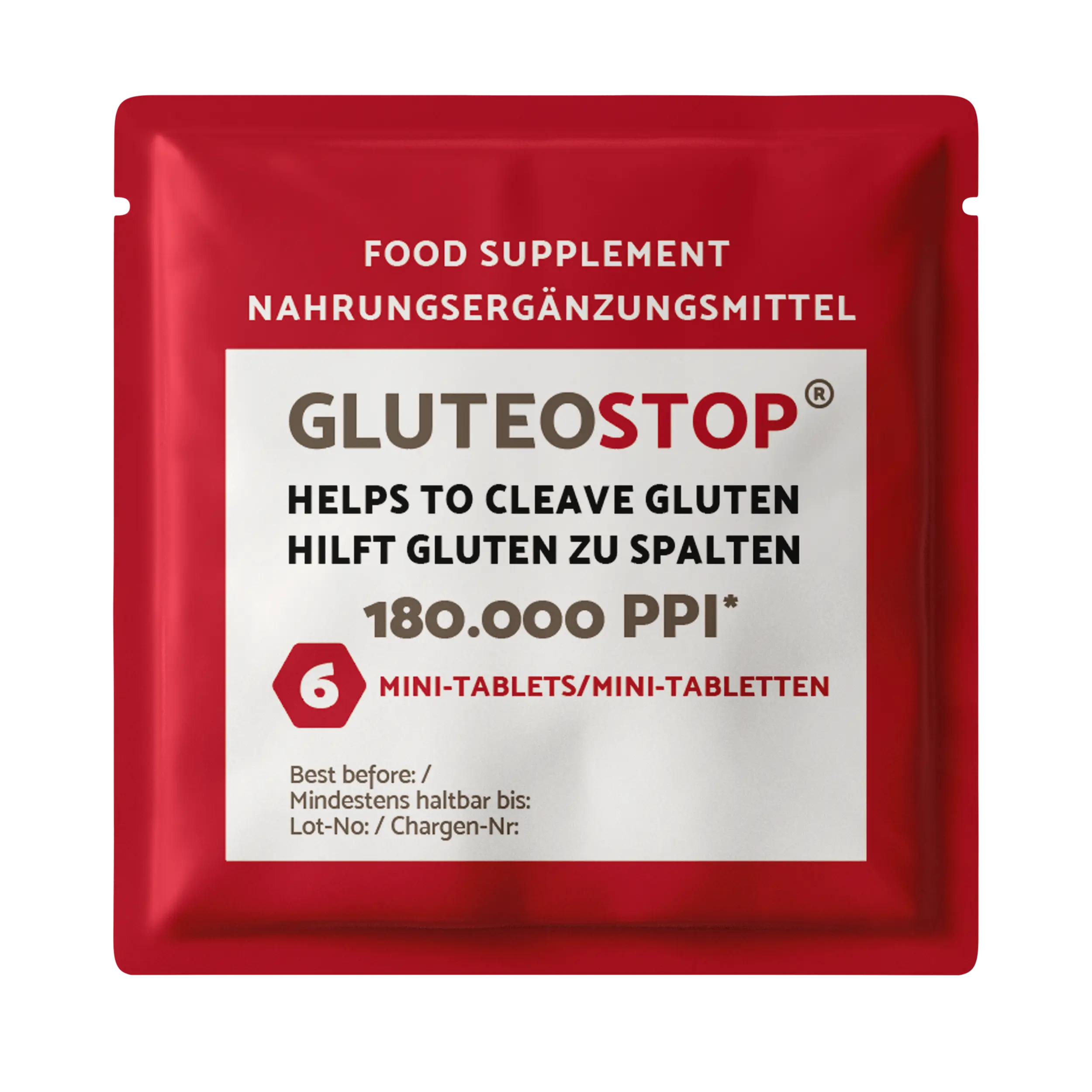
GluteoStop® is intended to functionally support the breakdown of gluten in a low-gluten or gluten-free diet. It cannot replace a gluten-free diet and is not intended for the treatment or prevention of celiac disease, wheat allergy, or gluten hypersensitivity. The use of the enzyme in GluteoStop® is approved for the general adult population up to an equivalent amount of 45 tablets per day.