


Any questions? We're happy to help.
Check out our FAQs or contact us directly:
info@gluteostop.com

Gluten & Intolerances

About GluteoStop®

Intake & Dosage

Health & Safety

Ingredients & Nutrition

Purchase, Storage & Shelf Life
Gluten & Intolerances
What is gluten?
Gluten is the storage protein found in certain types of grain, which gives them their baking properties. Grains such as wheat, spelt, rye, barley, green spelt, and oats contain gluten – as do all products made from them. Even ancient grains like einkorn and emmer contain gluten. Gluten forms the basis for grain flour becoming a sticky dough during processing and is important, for example, in bread making for the increase in dough volume and the consistency of the baked goods. Gluten is a protein with an unusually high amount of the amino acid proline, which makes it difficult to digest. It cannot be completely broken down in the gastrointestinal tract because the human intestine does not have sufficient amounts of the necessary digestive enzymes, known as prolyl oligopeptidases or prolyl endopeptidases (PEP).
What are the symptoms of gluten/wheat sensitivity?
Symptoms often begin relatively quickly after consuming gluten-containing foods and disappear just as quickly within a few days on a gluten-free diet. Affected individuals report abdominal pain, bloating, diarrhea or constipation, headaches, brain fog, fatigue, joint and muscle pain, skin changes, depressive moods, and anemia. In children, gastrointestinal complaints and fatigue are more common.
What are the different types of reactions to gluten?
A distinction is made between three types of gluten intolerance triggered by gluten or gluten-containing grains:
- CELIAC DISEASE (AN AUTOIMMUNE DISEASE)
- WHEAT ALLERGY
- GLUTEN OR WHEAT SENSITIVITY
(so-called Non-Celiac Non-Wheat Allergy Wheat Sensitivity / Non Celiac Gluten Sensitivity (NCGS))
What exactly is gluten or wheat sensitivity, and how can I tell if I have it?
Gluten or wheat sensitivity was already described in the 1980s, but has only recently gained increasing attention and importance. This non-celiac non-wheat allergy wheat sensitivity is an intolerance to certain wheat components. So far, there are no valid test systems to prove gluten/wheat sensitivity. The diagnosis can currently only be postulated after the exclusion of celiac disease and a wheat or gluten allergy, as well as with a clinical improvement on a gluten-free diet.
What makes oats special?
Oats and products made from oats that are not contaminated with gluten-containing grains are permitted as part of a gluten-free diet if no complaints or symptoms occur upon consumption.
How can I tell if I have a gluten sensitivity?
Currently, gluten sensitivity cannot be detected through markers or blood tests. The absence of a reliable biomarker, i.e., a measurable indicator for gluten sensitivity, as well as the non-specific symptoms, mean that diagnosis can only be made by exclusion. Celiac disease and wheat allergy in particular must be clearly ruled out beforehand. If this is the case, a gluten-free diet is tested. If the symptoms significantly improve and then worsen again as soon as gluten is reintroduced, the diagnosis of gluten/wheat sensitivity is confirmed.
Why am I gluten intolerant?
There can be very different reasons why someone has gluten intolerance. If celiac disease and wheat allergy have been clearly ruled out beforehand, the cause may be a so-called non-celiac, non-wheat allergy gluten sensitivity. Gluten is a protein with an unusually high amount of the amino acid proline, which makes it difficult to digest. It cannot be completely broken down in the gastrointestinal tract because, for example, the necessary digestive enzymes, the prolyl oligopeptidases or prolyl endopeptidases (PEP), are not sufficiently present in the human intestine.
Is gluten sensitivity a disease?
Unlike celiac disease or lactose intolerance, gluten sensitivity is not listed as a disease in the WHO's ICD register (http://www.who.int/classifications/icd/en/) and is therefore not classified as a disease.
Is this an allergic reaction?
Gluten sensitivity and wheat allergy – similar in their symptoms and can therefore be easily confused. But there are differences, e.g. regarding reaction times and pathogenesis. Wheat allergy is an IgE-mediated immune system reaction to wheat components, which usually triggers an immediate reaction within a few minutes to hours. Late reactions are less common. Even if people with gluten sensitivity develop similar symptoms after consuming gluten-containing foods, the consequences are usually less severe.
Should I avoid foods that contain gluten?
Those who suffer from gluten intolerance should strictly avoid gluten-containing foods and follow a strict gluten-free diet. Unfortunately, this is still the only option for an intolerance today. However, research is frantically working on novel forms of therapy.
How can I tell if food contains gluten?
Since November 2005, 14 allergens in food, including "cereals containing gluten and products thereof," must be declared on the packaging if they are present as an ingredient in the product, regardless of the form or quantity contained therein. Information on allergens is now also mandatory for unpackaged goods. The information can be provided in writing, electronically, or orally.
Special "gluten-free" products are marked with the "crossed-grain symbol," which is awarded by celiac societies. However, this is a voluntary declaration and does not guarantee that a product is gluten-free. Foods with a gluten content of no more than 20 mg/kg (= 20 ppm) are considered gluten-free.
All foods containing wheat, spelt, khorasan wheat, triticale, barley, and rye contain gluten. Oats should also be avoided as they are often contaminated with gluten. Foods that may contain gluten or wheat as an ingredient or additive are risky. Examples include ready meals, sausages, soy sauces, and ice cream. For these foods, it is particularly important to read the ingredient information on the packaging carefully. Foods that may have been contaminated with gluten during production are also risky.
About GluteoStop®
What is GluteoStop®?
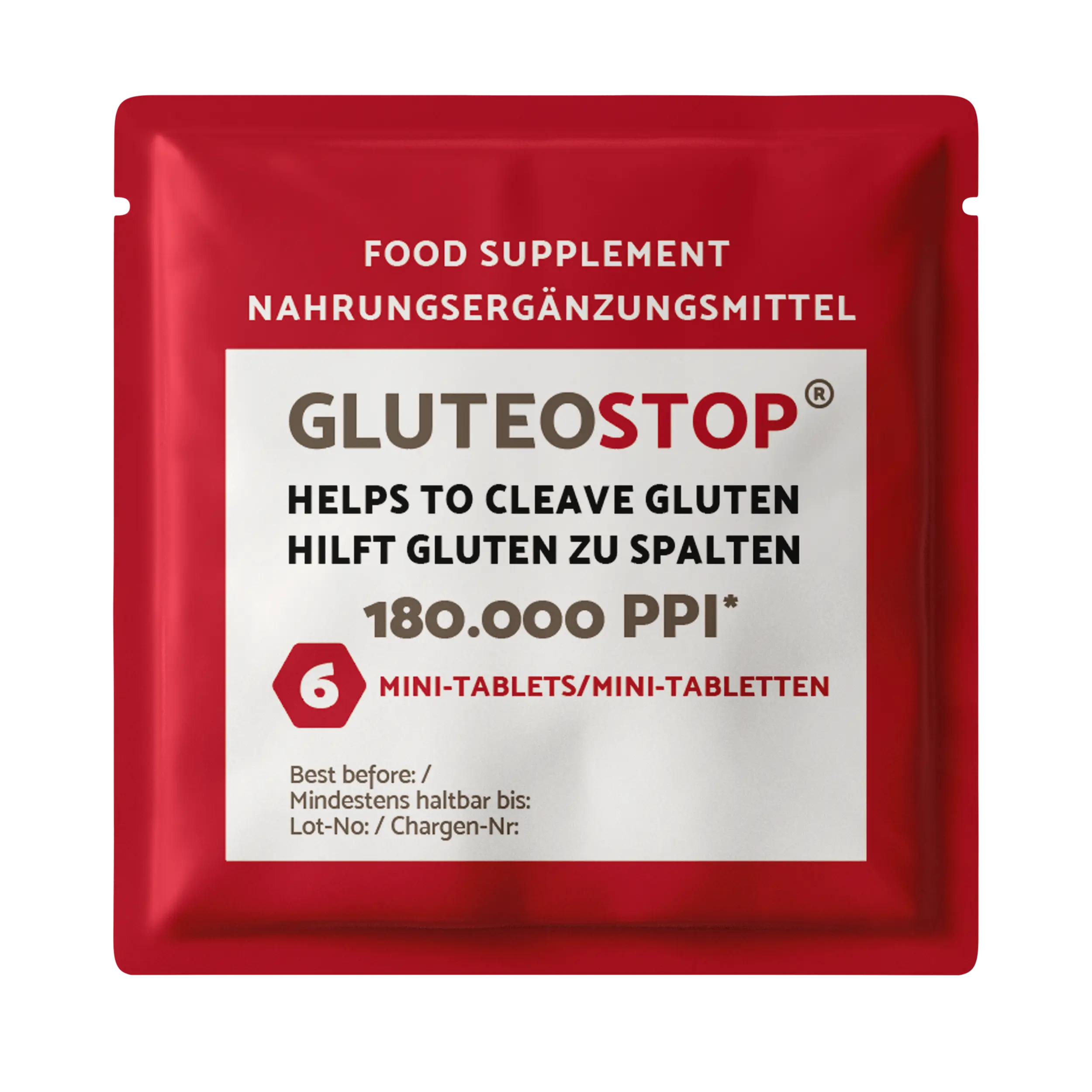
GluteoStop® is a dietary supplement and is exclusively intended to functionally support the breakdown of gluten in a low-gluten diet. GluteoStop® cannot replace a gluten-free diet and is not intended for the treatment or prevention of celiac disease, wheat allergy, or gluten hypersensitivity. GluteoStop® contains a special enzyme, prolyl oligopeptidase, which cleaves the amino acid chains (peptides) in gluten. In this way, gluten can be broken down. GluteoStop® is therefore ideal for anyone who eats a gluten-free diet and wants to prevent the intake of trace amounts of gluten or "hidden gluten" in food.
What are the benefits of GluteoStop®?
- Practical for on the go in a handy click dispenser
- Mini tablets, easy to swallow even without liquid
- Discreet application e.g. in restaurants, canteens, while traveling and with friends
- Free from: sugar, lactose, fructose, gluten, sweeteners, colorants, flavorings, preservatives, magnesium stearate
- Efficacy proven in clinical studies
- Made in Germany
- Vegan
Can GluteoStop® help me, even if I'm already following a gluten-free diet?
GluteoStop® cannot replace a gluten-free diet but is an additional aid to reduce small amounts of unintentionally ingested gluten in a supposedly gluten-free diet. Recent scientific studies from 2018 (Am J Clin Nutr. 2018 Feb 1;107(2):201-207) have shown that even celiac disease patients who must follow a strict gluten-free diet unintentionally ingest an average of 150-400mg of gluten per day. For many affected individuals, this leads to typical disease symptoms and prevents their intestinal mucosa from regenerating.
Are there any clinical studies that demonstrate its effectiveness?
Numerous clinical studies have shown that gluten can be broken down by the prolyl oligopeptidase used. The enzyme used in GluteoStop® is the first commercially available protease enzyme that has proven effective in both in-vitro studies and human clinical trials. Scientists at Maastricht University showed in a randomized, placebo-controlled study that this enzyme was very effective in breaking down gluten and that a large portion of the gluten was broken down in the stomach within a short period.
We are happy to provide relevant information to healthcare professionals. Unfortunately, we are not legally permitted to provide studies to users without scientific and medical training.
What do PPI units mean?
PPI stands for "Protease Picomole International". The PPI value indicates enzyme activity.
Do all peptidases work the same way?
Peptidase is a collective term for enzymes that can break down amino acids. However, each peptidase is specific, breaks down different amino acids, and functions under different conditions. The enzyme used in GluteoStop® is a prolyl endopeptidase and is an enzyme specific to the amino acid proline. This special enzyme was developed to achieve its optimal effect under the acidic conditions of our stomach. This enzyme used in GluteoStop® is the first protease enzyme that has proven effective in human clinical studies, demonstrating that a large portion of gluten was broken down quickly, already in the stomach.
What is GluteoStop® derived from?
The enzyme contained in GluteoStop® is obtained in a fermentation process using the microorganism Aspergillus niger. This microorganism has been used for the production of citric acid since 1919. Since the 1960s, it has been used industrially for enzyme extraction. The enzyme is then purified in a very complex process and finally granulated into a powder.
How is GluteoStop® different from other enzyme products?
There are numerous enzyme products on the market. GluteoStop® is a peptidase. Peptidase is a collective term for enzymes that can break down amino acids. However, each peptidase is specific, meaning it breaks down different amino acids and functions under different conditions. The enzyme used in GluteoStop® is a so-called prolyl endopeptidase and is an enzyme specific to the amino acid proline. This special enzyme has been developed to achieve its optimal effect under the acidic conditions of our stomach. This enzyme used in GluteoStop® is the first protease enzyme that has proven effective in clinical human studies, showing that a large part of gluten was already broken down in the stomach within a short time. A comparison of different peptidases showed that the prolyl oligopeptidase used in GluteoStop® can break down gluten much more efficiently than other peptidases (e.g., DPP-IV dipeptidyl peptidase).
Where is GluteoStop® manufactured?
GluteoStop® is manufactured in Germany, and the enzyme used in GluteoStop® is manufactured in France.
Intake & Dosage
How do I know what the correct dosage is?
The recommended intake is 1-2 tablets per meal. If you have a protein-rich meal or increased dairy products in your diet, you should increase the number of tablets. However, the maximum recommended intake of 6 tablets per day should not be exceeded. The tolerance threshold in people with non-celiac gluten sensitivity is very different, meaning that the intake of gluten or the dosage of GluteoStop® must be individually tested and adjusted accordingly.
How much gluten can be broken down with one tablet?
Unfortunately, no single number can be given here, as the activity of the enzyme in breaking down gluten is highly dependent on the other food components. The recommended intake and enzyme quantity per tablet were chosen based on the results of various clinical studies. The literature describes the average, unintentional intake of "hidden" gluten in a gluten-free diet as 150 - 400 mg per day. In the most recent clinical human study, accordingly, 500 mg of gluten was added to a standardized diet for subjects, and it was shown that by administering 83,300 PPI enzyme, approximately 87% of the added gluten could be broken down.
Can I take GluteoStop® every day?
Yes, as a food supplement, GluteoStop® is intended to be taken every day.
How many tablets can I take in a day?
The recommended intake is one to two tablets per meal, meaning the daily recommended intake is six tablets per day.
What is the maximum permitted dose of GluteoStop®?
The recommended intake for GluteoStop® is one to two tablets per meal, meaning the daily recommended intake is six tablets per day. The recommended daily dose must not be exceeded. The European Food Safety Authority (EFSA) has classified a daily dose of up to 2.7g propyloligopeptidase as safe in its safety assessment. This would correspond to 45 GluteoStop® tablets.
Can the effectiveness of GluteoStop® be further enhanced?
Scientific studies show that the activity of the enzyme in GluteoStop® can be further enhanced if the tablets are taken with carbonated drinks. Drinks with a low pH value such as mineral water, acidic juices, cola etc. cause the chyme in the stomach to reach a pH value of around 4.5 more quickly, at which the enzyme shows its highest activity.
What can negatively affect the effectiveness of GluteoStop®?
The enzyme used in GluteoStop® is a so-called protease. This means that it can break down protein. The consumption of large quantities of dairy products (milk protein) can reduce the activity of GluteoStop® in breaking down gluten. Like gluten, milk protein contains an unusually high amount of the amino acid proline, so milk protein is also broken down by our enzyme. Therefore, the dose of GluteoStop® should be increased when consuming a meal rich in milk protein. For this reason, one should avoid drinking a glass of milk directly with the intake of GluteoStop® and instead preferably consume an acidic drink to increase enzyme activity (see also question: "Can GluteoStop® activity be further increased?").
Health & Safety
Can people with celiac disease also use GluteoStop®?
GluteoStop® is gluten-free and can generally also be used by celiac disease sufferers. For celiac disease sufferers, GluteoStop® is a useful, additional aid to further reduce the daily, unintentional gluten intake in a strict gluten-free diet. The prerequisite is the correct application of GluteoStop®. Many studies show that celiac patients unintentionally ingest gluten despite a strict gluten-free diet, on average 150-400 mg per day. This leads to symptoms in many affected individuals. The German Celiac Society also reports on its homepage about enzyme therapy with prolyl endopeptidases (PEPs) as one of the possible therapeutic approaches of the future. (https://www.dzg-online.de/)
IMPORTANT: GluteoStop® cannot replace a gluten-free diet and is not intended for the treatment or prevention of celiac disease. GluteoStop® is a dietary supplement and is exclusively intended to functionally support the breakdown of gluten in a low-gluten diet.
Is the enzyme (prolyloligopeptidase) harmful to my body?
The enzyme was extensively studied by the European Food Safety Authority (EFSA) and assessed as safe. Subsequently, the enzyme was approved EU-wide as a "Novel Food." It is important to adhere to the recommended consumption guidelines.
Can I take GluteoStop® while I'm pregnant or breastfeeding?
All ingredients in GluteoStop® are approved as food and food supplements. There are no known indications for the individual ingredients that they should not be taken during pregnancy and breastfeeding.
For this reason, no data known to us contradict taking GluteoStop® during pregnancy and breastfeeding. However, since no direct product-specific studies on the use of GluteoStop® during pregnancy and breastfeeding are available, we ask you to discuss the use with your doctor.
Can children take GluteoStop®?
Since no clinical studies have yet been conducted on children, approval of the enzyme used in GluteoStop® could initially only be applied for for the general adult population. In 2017, the European Commission approved the GluteoStop® AN-PEP enzyme accordingly for the general adult population.
GluteoStop® is a dietary supplement and thus falls under food law. As a matter of principle, a food product must be safe. Therefore, for novel foods, the safety of a product is examined by the EFSA (European Food Safety Authority). In its assessment, the EFSA considered a wide range of clinical studies and data. At that time, no studies on children were available, so the EFSA could not make an assessment for children based on the submitted studies. Therefore, the enzyme used in GluteoStop® was initially only approved in Europe for the adult population, and a maximum dose was set, which would correspond to 45 mini-tablets of GluteoStop®.
In Australia, on the other hand, a recommendation for children from 36 months could be issued for the enzyme, as different regulations for the assessment of dietary supplements apply there.
Can I take GluteoStop® if I have diabetes?
GluteoStop® can also be taken by diabetics.
Can I take GluteoStop® even if I'm taking other dietary supplements?
GluteoStop® can be used with other food supplements. However, attention should be paid to the recommended daily intake of the products.
Are there any drug interactions?
No interactions with medications are known. If you regularly take medication, you should consult your doctor before the first application.
Ingredients & Nutrition
How many calories are in one tablet?
One tablet contains 0.263 kcal.
Energy value per tablet: 1.110 kJ / 0.263kcal
Energy value per 100 g: 1585 kJ / 375 kcal
Does GluteoStop® contain lactose or fructose?
GluteoStop® contains neither lactose nor fructose and is also free of dyes, preservatives, flavorings, sweeteners, palm oil, magnesium stearate, animal components, and genetically modified organisms.
Does GluteoStop® contain sweeteners or sugar?
GluteoStop® is free of sweeteners or sugar.
Does GluteoStop® contain preservatives, magnesium stearate, or palm oil?
GluteoStop® contains no preservatives and is also free from magnesium stearate, palm oil, lactose, fructose, colorants, flavorings, sweeteners, animal ingredients and genetically modified organisms.
Purchase, Storage & Shelf Life
Where can I buy GluteoStop®?
GluteoStop® is available at pharmacies – either directly on display or by ordering via the PZN (Pharmazentralnummer / central pharmaceutical number):
30 mini-tablets = 2.1g (PZN: 14398555)
90 mini-tablets = 6.3g (PZN: 14184771)
12-pack: 12 x 90 mini-tablets = 75.6g (PZN: 14359584)
Or directly from our webshop at: [www.gluteostop.com](https://www.gluteostop.com)
What is the best way to store GluteoStop®?
GluteoStop® should be stored in a cool, dry place away from light. It should also be kept out of the reach of small children.
Can I still take GluteoStop® even if the best-by date has passed?
The best-before date (BBD) is not an expiry date. Nevertheless, we recommend that you replace the product with one before the BBD expires, as only then can the stated enzyme activity be guaranteed.
How long can I use a product once I've opened it?
When stored properly, GluteoStop® can be used until the best-before date.
Is GluteoStop® also available by prescription?
As GluteoStop® is a food supplement, it is generally not reimbursed by statutory health insurance companies.
Why is GluteoStop® so expensive?
Ineo Pharma GmbH invests in the quality of raw materials for its product GluteoStop®, producing it to the highest food quality standards in Europe and exclusively in Germany. We voluntarily have our quality assurance regularly audited. We can trace every single one of our packages. Furthermore, we invest in expertise, science, and exceptional service. Our team of natural and nutritional scientists personally and competently answers every question from doctors, pharmacists, and consumers.