

Can gluten be the cause of skin problems?
Can gluten trigger skin problems? Many people ask themselves this question when, after consuming gluten, they not only experience stomach pain, diarrhea, or bloating, but also itching, rashes, or other skin changes. In fact, celiac disease and gluten sensitivity can affect much more than just the digestive system. A particularly well-known example is dermatitis herpetiformis Duhring, also known as Duhring's disease. It is considered a skin manifestation of celiac disease and shows that, in certain cases, a reaction to gluten can also become noticeable on the skin. At the same time, skin complaints can have many possible causes. Therefore, it should always be medically clarified whether gluten intolerance symptoms affect the skin or whether another skin condition is behind it.
Properly categorizing skin symptoms of gluten intolerance
Itching, skin rashes, or dry skin can have many causes. However, a possible connection between gluten and skin problems is also discussed in the context of celiac disease and gluten sensitivity.
Learn more
Celiac Disease, Gluten Sensitivity and Skin
In people with celiac disease, certain skin problems are more commonly reported. Individuals with non-celiac gluten sensitivity also sometimes report skin complaints after consuming gluten.
Learn more
Dermatitis herpetiformis Duhring: Cutaneous manifestation of celiac disease
Dermatitis herpetiformis Duhring is considered a classic skin manifestation of celiac disease. Severely itchy skin lesions, papules, and small blisters, frequently on the elbows, knees, or buttocks, are typical.
Learn more
Other Skin Conditions in Celiac Disease
Besides dermatitis herpetiformis, psoriasis, eczema, acne, chronic urticaria, and dry skin are also discussed in connection with celiac disease or gluten sensitivity.
Learn more
Properly Classifying Skin Symptoms of Gluten Intolerance
When Skin Problems Occur After Gluten
Gluten sensitivity, also known as NCGS, and celiac disease can affect much more than just the gut. The skin can also be involved, for example, in the form of itching, rashes, blisters, papules, dry skin, or inflammatory skin changes.
When such symptoms occur after consuming gluten, it can be very distressing for those affected. However, a rash does not automatically mean that celiac disease or gluten intolerance is present. Psoriasis, eczema, urticaria, allergies, or other skin conditions can also cause similar symptoms.
Why Gluten and Skin Are Difficult to Correlate
Gluten is found primarily in grains such as wheat, rye, barley, and spelt. In people with celiac disease, gluten consumption triggers an immune system reaction that can lead to inflammation and damage to the intestinal lining. In some affected individuals, additional skin problems occur.
With gluten sensitivity, the correlation is more difficult. Research has so far focused less on skin conditions in connection with NCGS. However, numerous reports indicate that some gluten-sensitive individuals who are not affected by celiac disease experience significantly fewer skin problems when they avoid gluten.²
Why Medical Clarification Is Important
Even if affected individuals observe an improvement on a gluten-free diet, this is not yet a definitive diagnosis. Skin diseases can have many causes and should be clarified dermatologically or medically. This is especially true for severe itching, blistering skin changes, or recurrent rashes.
Especially if celiac disease is suspected, it is important not to rush into a gluten-free diet. If gluten is consistently avoided before diagnosis, blood tests, antibodies, and further examinations may be more difficult to interpret.

Celiac Disease, Gluten Sensitivity, and the Skin
Skin Problems in People with Celiac Disease
About 15 to 25 percent of people with celiac disease suffer from dermatitis herpetiformis, a rash that is considered a skin manifestation of celiac disease. However, this is by no means the only skin problem that people with celiac disease and non-celiac gluten sensitivity may experience.
In one study, 29 percent of 486 patients suspected of having gluten sensitivity showed a rash. 18 percent of them had dermatitis that was not clearly diagnosed.¹ Such data show that skin changes related to gluten are discussed, even if the exact cause is not always clear.
Skin Problems with Gluten Sensitivity
Non-celiac gluten sensitivity is also internationally known as gluten sensitivity. Unlike celiac disease, there is no classic autoimmune disease with damage to the small intestinal lining. Nevertheless, some affected individuals report various symptoms after consuming gluten.
In addition to digestive problems, these can also include skin problems. Symptoms of gluten sensitivity affecting the skin are less scientifically well-documented than dermatitis herpetiformis Duhring in celiac disease. Nevertheless, some affected individuals report that skin changes improve with a gluten-free or low-gluten diet.²
Gluten-Free Diet and Possible Improvement
Although there is currently little clear medical evidence that gluten consumption actually causes all the mentioned skin diseases, affected individuals have often observed an improvement through a gluten-free diet. Skin problems associated with celiac disease range from itchy rashes to hair loss.
The correct classification remains important: a gluten-free diet is lifelong necessary for diagnosed celiac disease. For gluten sensitivity, a low-gluten or gluten-free diet can be helpful, but should ideally be done after medical consultation.
Dermatitis herpetiformis Duhring: Cutaneous manifestation of celiac disease
What is dermatitis herpetiformis Duhring?
Dermatitis herpetiformis Duhring is a chronic skin condition and is considered a skin manifestation of celiac disease. It is also known as Duhring's disease and is closely related to celiac disease. Typically, it presents with severely itchy skin lesions, papules, and small blisters.
The disease is rare, but very distressing for those affected. If dermatitis herpetiformis Duhring is diagnosed, it is assumed that celiac disease is also present. This should definitely be confirmed by appropriate diagnostics if the diagnosis of celiac disease has not yet been made.
Typical skin areas and symptoms
Dermatitis herpetiformis is a skin rash that can be triggered by the consumption of gluten. According to affected individuals, it is one of the most intensely itchy rashes. The lesions can not only itch but also sting and burn.
The skin changes can occur anywhere on the body. However, they are particularly common on the extensor surfaces of the extremities, such as the elbows and knees, as well as on the buttocks, lower back, scalp, and head and neck.
Diagnosis and treatment
If dermatitis herpetiformis Duhring is suspected, a dermatological and gastroenterological workup should be performed. Skin findings, blood tests, antibodies, and the clarification of celiac disease can play a role. The skin disease is often considered directly in connection with celiac disease.
The treatment of dermatitis herpetiformis is usually based on a strict gluten-free diet. For people with celiac disease, this means avoiding gluten for life. Depending on the severity, additional medical measures may be necessary, which are individually determined by a doctor.
Other skin conditions associated with gluten intolerance
Psoriasis, Eczema, and Acne
In addition to dermatitis herpetiformis, people with celiac disease may also suffer from eczema, psoriasis, acne, chronic dry skin, hives, and alopecia areata. For certain reasons, individuals with celiac disease are more frequently affected by these skin problems than the general population.
Psoriasis is an inflammatory, non-contagious skin disease. It is primarily characterized by reddish, scaly skin lesions that can be itchy. Several studies show that there may be a link between psoriasis and gluten consumption.³
Eczema and potential connection to celiac disease
Eczema is another itchy rash and often causes scaly, whitish patches on the skin. It occurs particularly frequently in children but can also affect adults. Although eczema is usually treated with topical glucocorticosteroids, there is evidence that it may be related to undiagnosed celiac disease in some people.⁴
For these individuals, a necessary, strict gluten-free diet can help treat their skin condition. However, this does not mean that every case of eczema is automatically triggered by gluten. An individual diagnosis is always crucial.
Acne, Urticaria, and Dry Skin
Some individuals with acne also report a reduction in their skin problems after switching to a gluten-free diet. However, there is currently no conclusive scientific evidence that gluten causes acne. Such observations should therefore be interpreted cautiously, and other causes should not be ruled out.
For chronic urticaria, commonly known as hives, there is evidence of possible links to celiac disease. A 2005 study found that 5 percent of children with chronic urticaria also had celiac disease. After the children were diagnosed with celiac disease and introduced to a gluten-free diet, the chronic urticaria disappeared within five to ten weeks.⁵ Very dry skin can also occur in people with celiac disease or gluten sensitivity and may partially improve after a change in diet.
Step by Step: Correctly Clarifying Skin Symptoms

Observe skin changes
If you regularly experience rashes, itching, blisters, papules, or dry skin, you should first observe when and in what context the symptoms occur. It is particularly relevant whether they worsen after consuming gluten or gluten-containing foods. A diary can be helpful to document your diet, skin symptoms, digestive issues, and possible triggers. This way, patterns can be better recognized and later discussed with a doctor.

Do not self-diagnose celiac disease and skin conditions
Even if the suspicion is obvious, a diagnosis should not be made by oneself. Skin diseases can have many causes, and skin symptoms related to celiac disease are not always clearly recognizable. Especially in cases of severe itching, blisters on the extensor surfaces of the extremities, or recurrent rash, it should be medically checked whether dermatitis herpetiformis Duhring, another skin disease, or celiac disease is present.

Get blood tests, antibodies, and other diagnostic tests done
In cases of suspected celiac disease, blood tests and antibodies can play an important role. An examination of the intestinal lining or small intestine lining may also be relevant, depending on the situation, to definitively diagnose celiac disease. For skin changes, additional dermatological diagnostics may be necessary. Particularly blistering, intensely itchy skin changes should be professionally evaluated by a specialist to initiate the appropriate treatment.

Don't eliminate gluten prematurely
Anyone who completely abstains from gluten before diagnosis can influence test results. Therefore, a gluten-free diet should ideally only be started after consulting a doctor if coeliac disease is suspected. This is especially true if a reliable diagnosis of coeliac disease is to be made or ruled out. Only after clarification can it be better decided whether a gluten-free diet, a low-gluten diet or another treatment is appropriate.

Long-term monitoring of diet and skin
If celiac disease is diagnosed, a lifelong gluten-free diet is necessary. In contrast, with gluten sensitivity, it may be sufficient to individually reduce gluten intake and pay attention to personal tolerance. In both cases, it is advisable to observe skin changes and symptoms over the long term. If skin problems do not improve despite a gluten-free diet or new symptoms occur, further causes should be medically investigated.
Common Questions About Skin Symptoms of Gluten Intolerance
Gluten intolerance symptoms affecting the skin can manifest, for example, as itching, skin rash, papules, small blisters, dry skin, or other skin changes. Dermatitis herpetiformis Duhring is particularly typical in connection with celiac disease.
Dermatitis herpetiformis Duhring is a rare, chronic skin disease and is considered a skin manifestation of celiac disease. It is typically characterized by severely itchy blisters and papules, often found on the elbows, knees, buttocks, scalp, or other extensor surfaces.
Yes, celiac disease symptoms can also affect the skin. The most well-known skin manifestation of celiac disease is dermatitis herpetiformis Duhring. In addition, other skin changes in connection with celiac disease are also discussed.
In the case of non-celiac gluten sensitivity, some affected individuals report rashes or other skin problems after consuming gluten. However, the connection is less clearly scientifically proven than with dermatitis herpetiformis and celiac disease.
No, skin problems are not automatically skin symptoms of a gluten allergy. The term "gluten allergy" is often used imprecisely in everyday language. In fact, skin rashes can have many causes and should be medically clarified if they are recurrent or severe.
For diagnosed celiac disease and dermatitis herpetiformis, a gluten-free diet is central. For other skin conditions, it may be helpful in individual cases but should not be understood as the sole treatment without a clear diagnosis.
Skin-related symptoms of gluten intolerance can manifest in various ways – from itching and rashes to blisters, papules, or dry skin. Of particular relevance is dermatitis herpetiformis Duhring, a rare skin manifestation of celiac disease, which is often associated with severe itching. Some individuals with gluten sensitivity also report skin changes after consuming gluten, although the scientific evidence for this connection is less clear. This makes a clear diagnosis all the more important: recurrent skin problems should always be medically evaluated before gluten is permanently avoided or a gluten-free diet is started.
Sources
- Volta U, Bardella MT, Calabrò A, Troncone R, Corazza GR; Study Group for Non-Celiac Gluten Sensitivity. An Italian prospective multicenter survey on patients suspected of having non-celiac gluten sensitivity. BMC Med. 2014 May 23;12:85.
- Antiga E, Maglie R, Quintarelli L, et al. Dermatitis herpetiformis: novel perspectives. Front Immunol. 2019;10:1290.
- Bhatia BK, Millsop JW, Debbaneh M, Koo J, Linos E, Liao W. Diet and psoriasis, part II: celiac disease and role of a gluten-free diet. J Am Acad Dermatol. 2014;71(2):350-8.
- Bonciolini V, Bianchi B, Del Bianco E, Verdelli A, Caproni M. Cutaneous manifestations of non-celiac gluten sensitivity: clinical histological and immunopathological features. Nutrients. 2015 Sep 15;7(9):7798-805.
- Caminiti L, et al. Chronic urticaria and associated coeliac disease in children: a case-control study. Pediatr Allergy Immunol. 2005 Aug;16(5):428-32.
Note
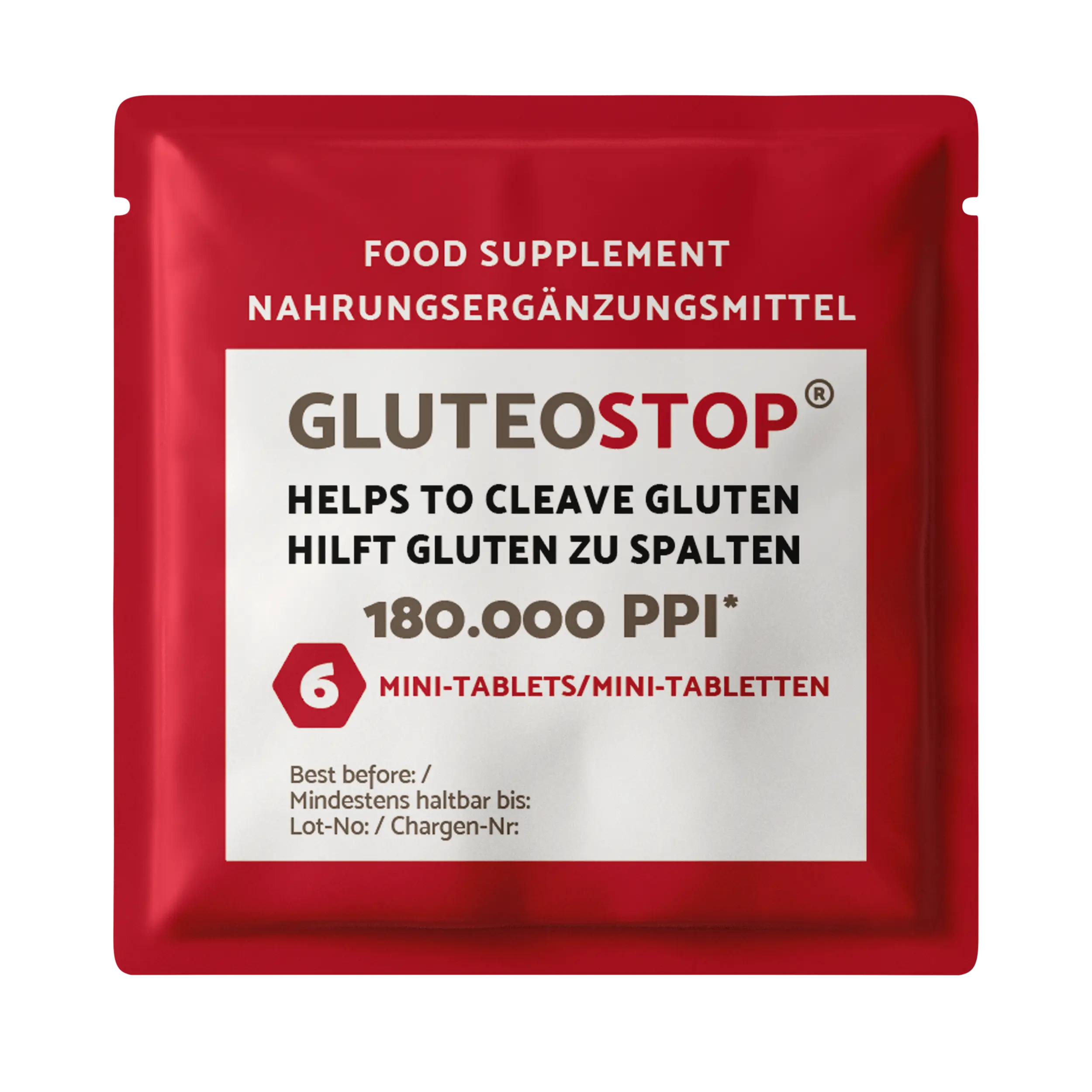
GluteoStop® is intended to functionally support the breakdown of gluten in a low-gluten or gluten-free diet. It cannot replace a gluten-free diet and is not intended for the treatment or prevention of celiac disease, wheat allergy or gluten hypersensitivity. The use of the enzyme in GluteoStop® is approved for the general adult population up to an amount equivalent to 45 tablets per day.