

GLUTEN CONTENT IN BEER - WHAT IS IT?
Beer brewed according to the German Reinheitsgebot (purity law) is made from hops, malt, yeast, and water. The malt, in turn, can be made from various grains (barley, wheat, rye), and since most grains contain gluten, beer is almost always taboo for people with celiac disease or gluten sensitivity (NCGS).
For someone suffering from an intolerance or sensitivity to gluten, even one glass of beer can be detrimental to their health.
What most of you don't know, however, is that the gluten content in beer can vary greatly depending on the type of beer. Beer lovers know that there are countless different types of beer on the market. The various beer types are distinguished by their brewing method and selected grains, and their taste and appearance differ accordingly. But not only the sensory properties, but also how much gluten the popular barley juice contains, sometimes varies considerably depending on the beer type and brewing method.
- Are you one of those people who suffer from celiac disease or a so-called gluten sensitivity (NCGS)? Then you need to be very careful with all foods that contain grains. Liquid food, like beer, is no exception!
- However, for those with celiac disease, this will not matter, because even commercial beer contains too much gluten for them.
- In contrast, for gluten sensitivity (NCGS), the varying gluten content of different beer types can be very crucial.
BEER FOR PEOPLE WITH CELIAC DISEASE
Brewers have addressed the problem and now offer gluten-free beer. Unfortunately, special gluten-free beer is often significantly more expensive than conventional beer, and taste, as we know, is debatable. The prices for gluten-free beer vary, but you can expect to pay around four euros or more per liter.
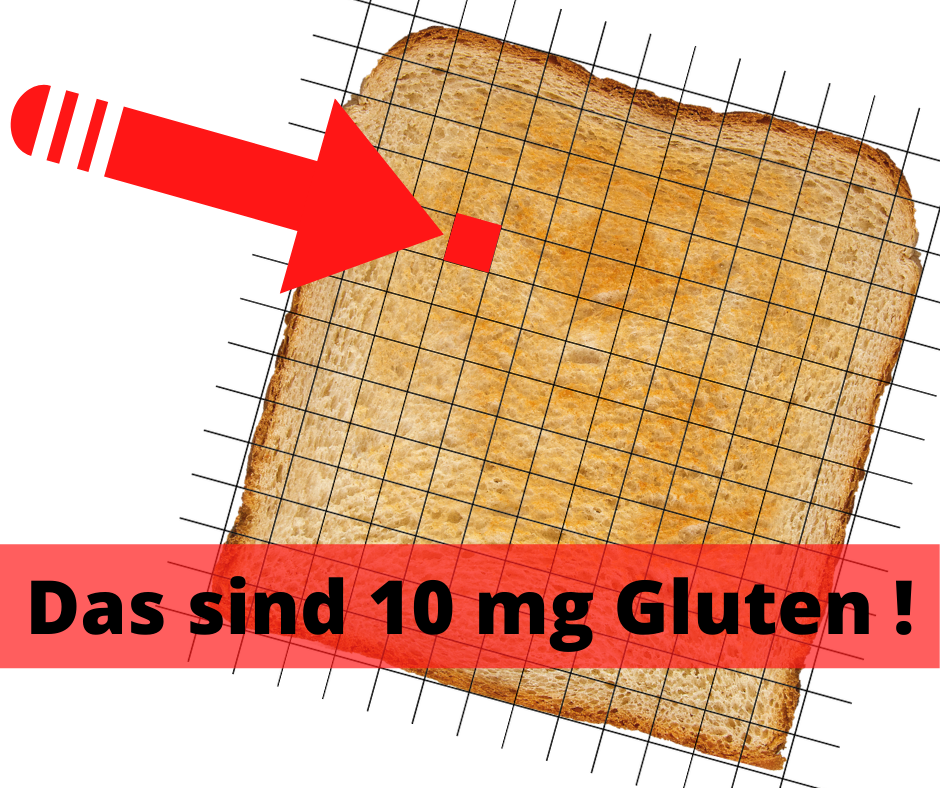
But be aware: a beer labeled "gluten-free" (crossed-out ear of grain) may, according to EU food law, still contain 20 mg of gluten per kg (approx. 1 liter). Thus, there is a risk that "a half" (0.5 liters of beer) could be enough to reach the guideline of 10 mg of gluten per day.
Interestingly, some "gluten-free" beers on the market are produced with the help of AN-PEP enzymes, or the gluten is reduced in the brewing process with the help of the enzyme to such an extent that this beer can be marketed as gluten-free beer.1 We use the same AN-PEP enzyme in GluteoStop.
GLUTEN IN BEER - HOW MUCH THE VALUES VARY HERE²
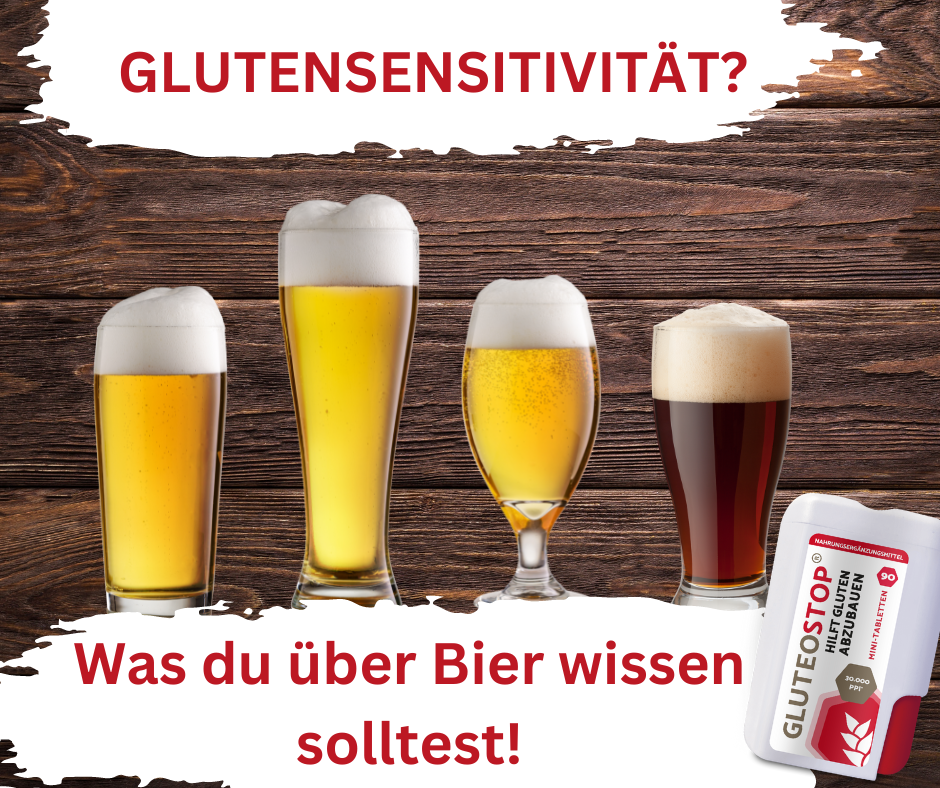
How much gluten is in a beer largely depends on the type of grain used and the brewing process. The bad news right at the beginning: Wheat beer (Weißbier), which is very popular not only in Bavaria, unfortunately has the highest gluten content. A liter of wheat beer contains around 250 milligrams of gluten and is therefore not recommended even for beer lovers with gluten sensitivity. Nevertheless, there are types of beer whose gluten content is many times lower, and gluten-sensitive beer lovers might therefore tolerate a glass or two.
Pilsener Lager (Pilsener Urtyp) contains by far the lowest gluten content, with only about 1.2 milligrams of gluten per liter. Some gluten-sensitive individuals should tolerate this in small quantities. To be on the safe side, however, one should still take the daily dose of GluteoStop.
Light lager (helles Vollbier) follows with approximately 2.7 milligrams of gluten per liter.
A dark lager (dunkles Vollbier), on the other hand, has almost twice as high a gluten content as light lager, with about 4.6 milligrams per liter.
If you think that an alcohol-free beer or malt beer (e.g., Vitamalz) is gluten-free, you are greatly mistaken. In fact, alcohol-free beers or malt beers contain more gluten than Pils beer, with approximately 3.2 and 3.3 milligrams of gluten per liter, respectively. Alcohol-free beer is also not an alternative for beer lovers suffering from celiac disease; nevertheless, they should not have to do without their beer. As described above, there are now some providers whose beer is marked with the crossed-out ear of grain. It should be noted that the seal only confirms that the beer has less than 20 mg of gluten per kilogram, i.e., approx. 1 liter.
Therefore, we recommend that gluten-sensitive individuals take GluteoStop® before consuming gluten-free or low-gluten beer to reduce the burden of residual gluten.
SOURCE:
1 Michiel Akeroyd, Sylvie van Zandycke, Joost den Hartog, Jozé Mutsaers, Luppo Edens, Marco van den Berg & Chantal Christis (2016) AN-PEP, Proline-Specific Endopeptidase, Degrades All Known Immunostimulatory Gluten Peptides in Beer Made from Barley Malt, Journal of the American Society of Brewing Chemists, 74:2, 91-99, DOI: 10.1094/ASBCJ-2016-2300-01
2G. Andersen / H. Köhler in cooperation with M. Rubach / W. Schaecke (2015): Annual Report of the German Research Center 2014, Freising, pp. 136 – pp. 139

Share:
Gluten Content – the 10 mg Limit
Gluten content in food