

Anyone who believes that they can rely exclusively on the "correct" labelling on products may be exposed to a high, unwanted gluten load.
Coeliac disease (CD) is a systemic immune-mediated disease caused by the ingestion of gluten in genetically susceptible individuals. It is one of the most common lifelong diseases, affecting approximately 1% of the population in Europe and North America (1,2). The only available treatment for coeliac disease is the gluten-free diet (GFD), which consists of the dietary exclusion of gluten-containing grains (i.e., wheat, rye, barley, triticale, durum wheat, spelt, and kamut) (3). Despite the recognised effectiveness of the gluten-free diet, strict adherence to it is very difficult to achieve, with several studies reporting that up to 50% of coeliac patients experience intentional and unintentional gluten intake (3,4). Prolonged intake of trace amounts of gluten (10–50 mg daily) can damage the small intestinal mucosa (5). In a recent study, the average unintentional gluten exposure of coeliac patients was estimated at approximately 150–400 mg/day (mean), with a high proportion of coeliac patients routinely consuming more than 200 mg of gluten per day (6).
Not every affected person reacts to hidden gluten
Only 10 to 20 percent of coeliac sufferers have the so-called full clinical picture of coeliac disease - many have atypical or no symptoms at all and therefore suspect nothing of their illness for a long time. In many cases, however, the disease only manifests itself indirectly through the consequences of malnutrition. For example, iron deficiency can cause anaemia or insufficient calcium intake can lead to osteoporosis. If gluten intolerance remains undetected, malnutrition can lead to developmental delays in children and adolescents. In adults, further complications such as infertility and colon cancer are threatened.
What do we mean by "hidden" gluten?
By "hidden gluten", we mean gluten in products that is not apparent or visible to the consumer. And there are various reasons for this:
1) Residual gluten in gluten-free products: in Germany, 20ppm (2mg/kg) may still be contained here. Even foods with 100ppm gluten may still be advertised as "specially formulated for people with coeliac disease" if the food has been produced in a special way to reduce the gluten content. (7)
2) Foods that have been contaminated with gluten. Either during production or preparation. The food inspection authorities use a threshold of 80 ppm. Anything below this is not pursued. Studies have shown that gluten-free pasta cooked in the same water as gluten-containing pasta contained up to 115.7 ppm gluten. (8)
3) Incorrectly or unlabelled foods. It is a misconception that all foods in Germany are correctly labelled. Every year, the investigation offices of the Baden-Württemberg food inspection authorities publish their allergy balance. A report that also examines gluten.
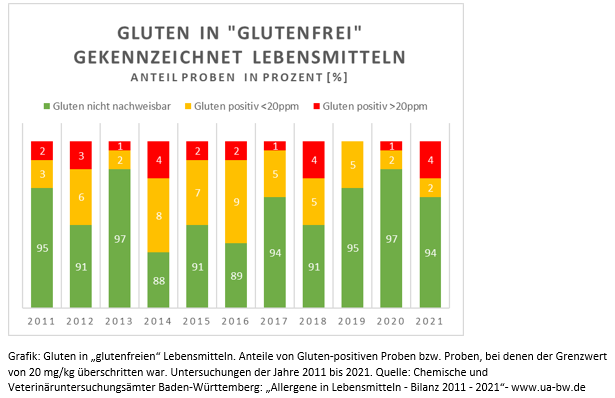
Products labelled as "gluten-free" are also examined. It was found that in recent years, gluten has repeatedly been found in actually gluten-free products. The peak was in 2021 with 6% of the samples examined, after 2014 and 2018, with almost 4% even exceeding the maximum permissible value of 20 ppm. Since this is then a product harmful to the health of coeliac sufferers, the products were publicly recalled.
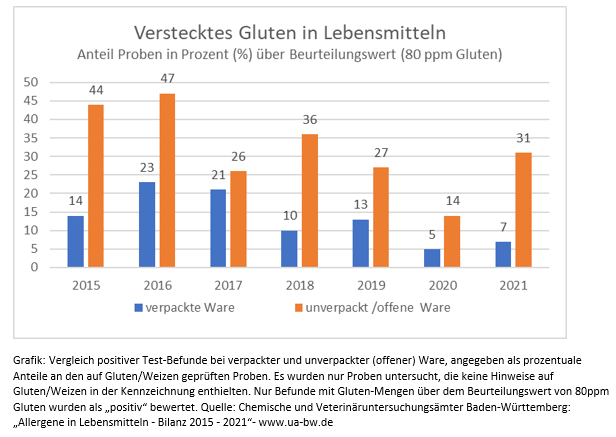
In addition to the "gluten-free" labelled products, hundreds of classic convenience products were also examined each year. Both pre-packaged products and unpackaged products (open counter) were examined. It is striking that many incorrectly labelled products were found, especially among convenience products. In 2016, 23% of all packaged products examined exceeded the threshold of 80 ppm and were complained about, while in 2021, 31% of all unpackaged products examined still contained gluten (>80ppm), although gluten was not labelled. (9,10)
Therefore, anyone who believes that they can rely exclusively on the "correct" labelling on products, in restaurants, or when travelling and with friends, may be exposed to a high, unwanted gluten load.
The goal of every person affected by gluten intolerance must be to ingest as little gluten as possible, and enzymes can help here as an additional aid to a "supposedly" gluten-free diet.
It is clear, however, that an enzyme product like GluteoStop cannot replace a gluten-free diet. BUT it can help reduce unwanted and unwitting exposure to gluten in addition to a gluten-free diet. And ultimately, that's what it's all about: adding as little gluten as possible to your body.
SOURCE:
1. Fasano A, Catassi C. Clinical practice. Celiac disease. N Engl J Med 2012;367:2419–26.
2. Lionetti E, Castellaneta S, Francavilla R, et al. Introduction of gluten, HLA status, and the risk of celiac disease in children. N Engl J Med 2014;371:1295–303.
3. Lionetti E, Catassi C. New clues in celiac disease epidemiology, pathogenesis, clinical manifestations, and treatment. Int Rev Immunol 2011;30:219–31.
4. Hall NJ, Rubin G, Charnock A. Systematic review: adherence to a gluten-free diet in adult patients with coeliac disease. Aliment Pharmacol Ther 2009;30:315–30.
5. Catassi C, Fabiani E, Iacono G, et al. A prospective, double-blind, placebo-controlled trial to establish a safe gluten threshold for patients with celiac disease. Am J Clin Nutr 2007;85:160–6.
6. Syage JA, Kelly CP, Dickason MA, et al. Determination of gluten consumption in celiac disease patients on a gluten-free diet. Am J Clin Nutr 2018;107:201–7.
7. COMMISSION IMPLEMENTING REGULATION (EU) No 828/2014 of 30 July 2014 on the requirements for the provision of information to consumers on the absence or reduced presence of gluten in foods
8. Weisbrod VM, Silvester JA, Raber C, McMahon J, Coburn SS, Kerzner B. Preparation of Gluten-Free Foods Alongside Gluten-Containing Food May Not Always Be as Risky for Celiac Patients as Diet Guides Suggest. Gastroenterology. 2020 Jan;158(1):273-275. doi: 10.1053/j.gastro.2019.09.007. Epub 2019 Sep 24.
9. Waiblinger HU, Schulze G. Action Levels for Food Allergens: An Approach for Official Food Control in Germany. J AOAC Int. 2018 Jan 1;101(1):17-22.
10. https://www.ua-bw.de/


Share:
Gluten in cosmetics?! We'll clear it up!
Gluten Alert! Enjoy Festivals Gluten-Free